

The Gorge Case Study

Case Study
Go behind the scenes of The Gorge with Image Engine to discover how we brought the skull spiders, hollowmen, and bodyweb to life through terrifying, plant-infused designs and haunting visual effects.
View portfolio page Watch breakdown reelScott Derrickson’s The Gorge is a genre-bending thriller that blends high-intensity action with eerie horror elements. The film follows Levi and Drasa, two highly trained operatives stationed on opposite sides of a vast and mysterious gorge, guarding against an unseen evil. As they uncover the horrifying truth about what lurks within, they must fight for survival against terrifying creatures and an environment that feels alive with danger.
Our team at Image Engine contributed to 181 visual effects shots in The Gorge for several key sequences, including the abandoned town, church attack, helicopter rescue, and the twisted bodyweb facility.
Read our Q&A with a few of our team members to find out how we brought these moments to life.
- Christian Irles, visual effects supervisor
- Katie Johnson, visual effects producer
- Ryan Woodward, CG supervisor
- Xander Kennedy, CG supervisor
- Jesus Lavin, compositing supervisor
- Gabriel Pires, compositing supervisor
- Richard Spriggs, animation supervisor
- Daniel Cox, concept artist
Creating the world of The Gorge
Q: What was it like working on a thriller film compared to previous projects?
Katie: I was incredibly excited to work on a Scott Derrickson project and have been a big fan of his movies, including Sinister and Deliver Us from Evil.
I found that working on a thriller like The Gorge, there is an emphasis on jump scare moments, which isn’t the case for all genres. Throughout our sequences, we really had to consider the timing. Derrickson worked very closely with his editor and often had particular notes on our creatures and their animation to make the perfect scare.
He wanted the audience to be unsuspecting of what was to come by subtly being able to spot our skull spiders crawling in the shadows, or have our hero get dragged. Christian and Richard Spriggs were quick to understand the importance of timing and capture the creepiness of the genre.
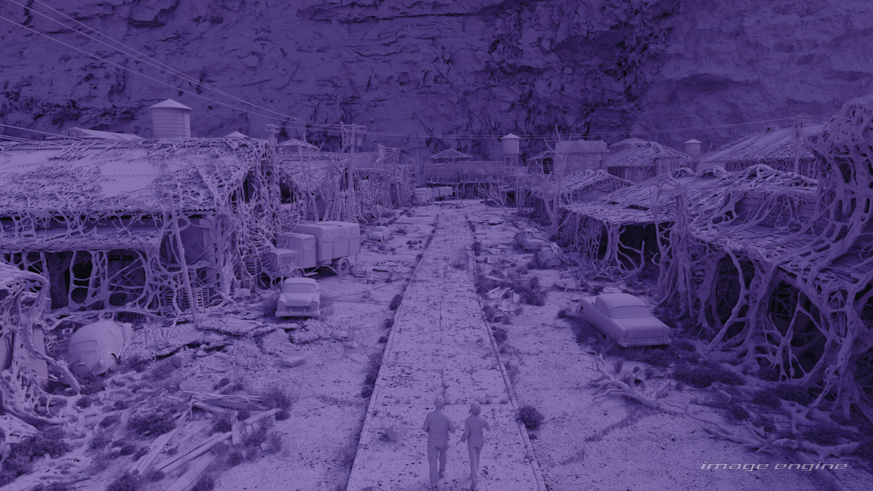
Q: How much of the environment was CG?
Ryan: The vast majority of the environment was CG for the abandoned town shots, the only exception being the extreme foreground, which includes the plate actors and some of the original set. Everything else was digitally created.
Jesus: We used CG set extensions for all shots in the sequence. We preserved the practical set wherever possible, but in some cases, we embellished it with CG and matte painting when needed.
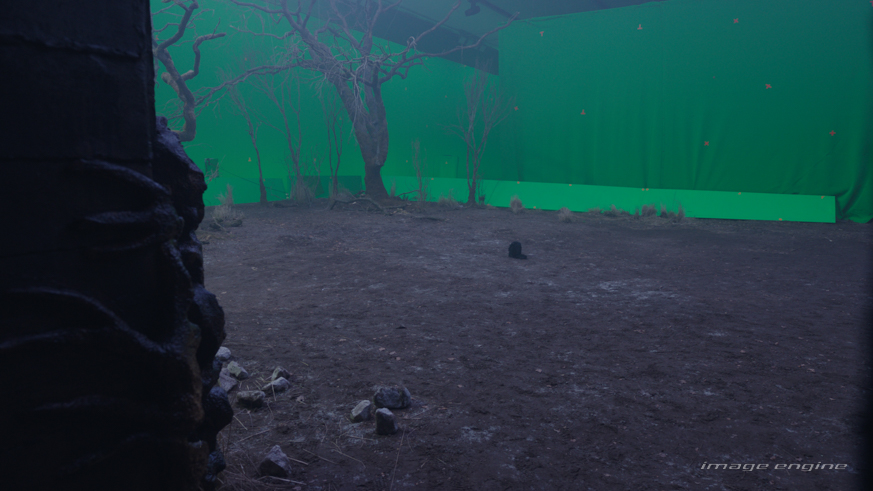
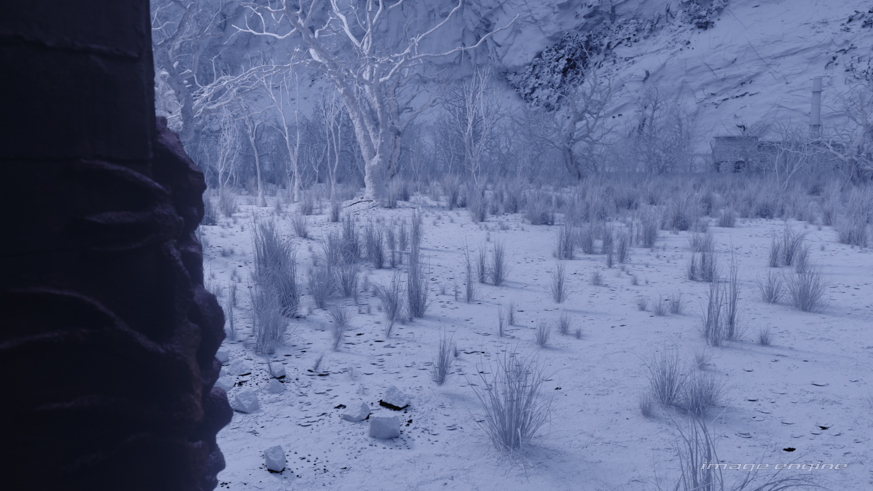
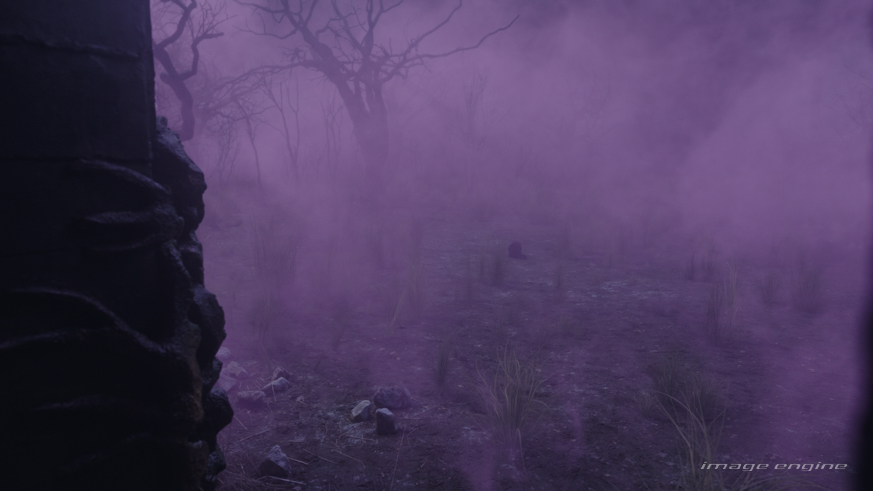
Q: Were there any particular challenges in integrating the CG environment with the live-action footage?
Ryan: The main challenge was blending the characters with the environmental fog. FX and comp had to work closely to integrate the fog with the plates. The lighting was another challenge in order to have something visually appealing, but also made sense with the live-action.
Jesus: Our goal is always hyperrealism. Keeping as much of the practical set as possible gave us valuable visual cues, making it harder for the audience to perceive what’s CG. The only time we replace live-action footage is when it looked fake itself. Integrating the thick, purple mist throughout the town was one of the most challenging parts of the project for the compositing department.
Skull spiders
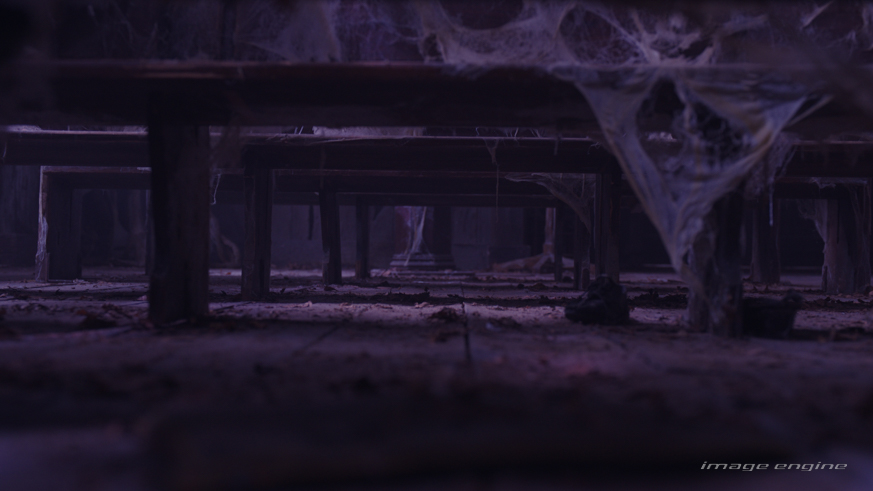
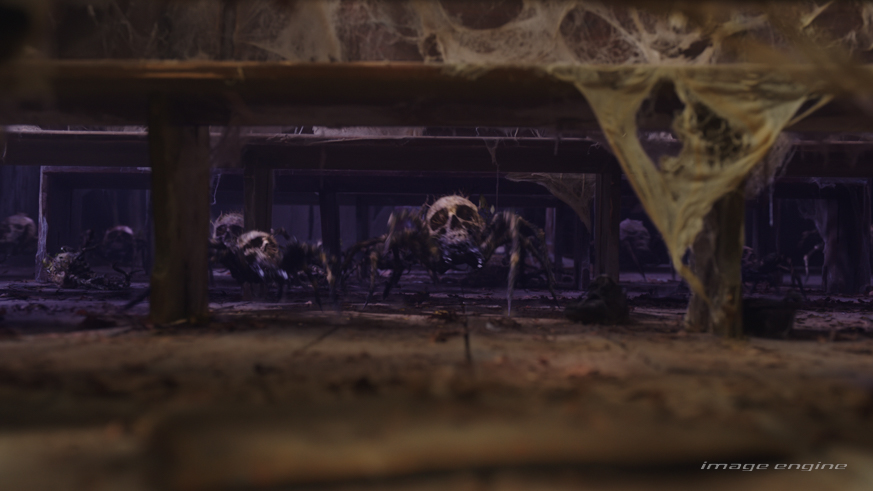
As Levi and Drasa enter an abandoned church, they move cautiously through the dusty, dark space. Cobweb-covered skeletons slumped in the pews hint at a long-forgotten horror. Suddenly, movement stirs in the shadows below the pews and waves of skull spiders scuttle toward the characters.
Q: How did you approach the design of the skull spiders?
Ryan: The client had already provided an initial 3D concept, which Daniel expanded upon, refining it into the base for our asset.
Daniel: The creature design phase was broken into three key categories: Skull Spiders, Hollowmen, and the Bodyweb. Each was developed into bespoke concept sets and keyframes to guide the project’s visual direction.
The post-vis provided a broad idea of the action, but it lacked visual clarity. We had questions like: was the creature still alive? How much was human versus plant matter? I worked closely with Christian Irles to establish a biological logic – merging plant roots with human anatomy to create a grotesque sense of transformation.
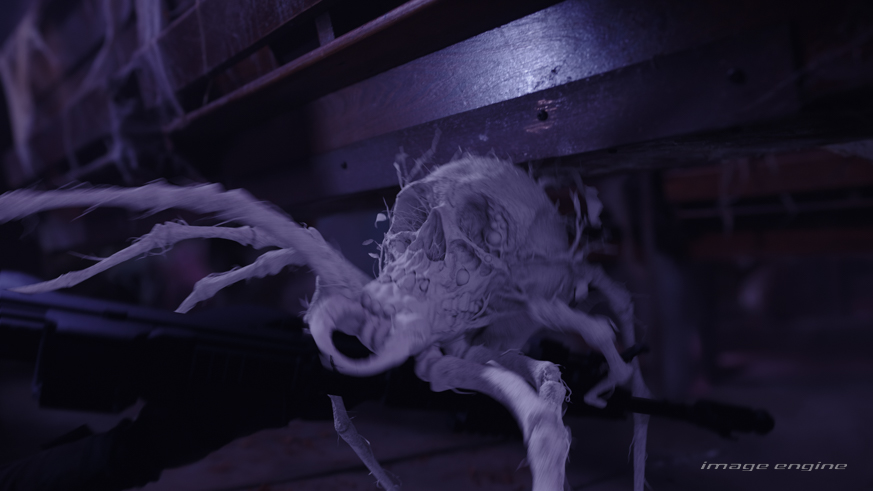
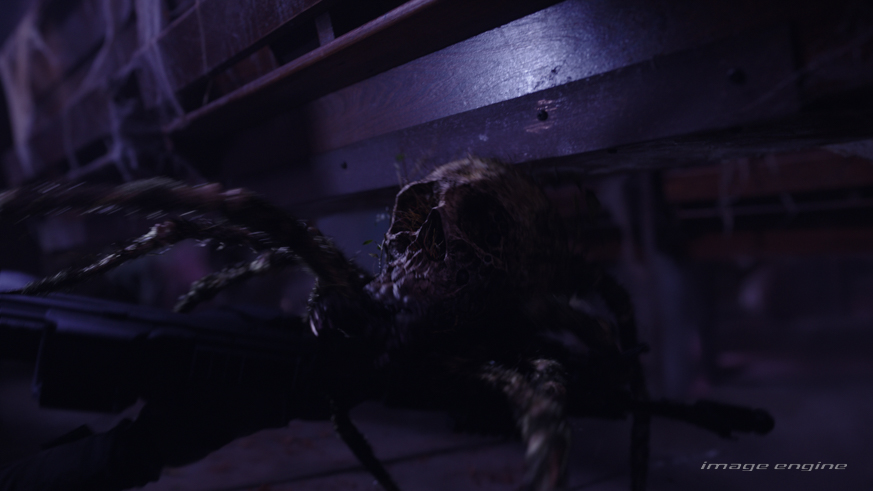
The skull spiders were our first completed creatures. I designed them as hybrids – skulls fused with spider-like anatomy, overgrown with moss and plant decay. Each felt like a spider wearing a skull cap rather than a traditional bone structure. I created detailed 4K renders that blended real spider references with organic decay to evoke a sense of unnatural growth.
Once approved, I explored alternate versions, like a cracked skull revealing composted tissue or distorted eye sockets, each pushing the mutation further and offering clear differences between the assets.
Q: What were the biggest challenges?
Ryan: Managing the number of spiders in motion during the action sequences was technically demanding. Memory limits were a concern, but the results were very successful. The match to the original concept and the level of detail in the spiders is excellent!
Richard: The skull spiders needed to feel aggressive and chaotic. The fast motion, as well as the constant bombardment of creatures helped make the scene feel overwhelming. We worked on adding very intricate details and different mutations. But once it got to the lighting team, we realized that a combination of dark lighting and fast motion hid too much detail, obscuring the skull shape. So we dialled it back and adjusted the silhouette for better readability while keeping that sense of frantic, skittering menace.
The hollowmen attack
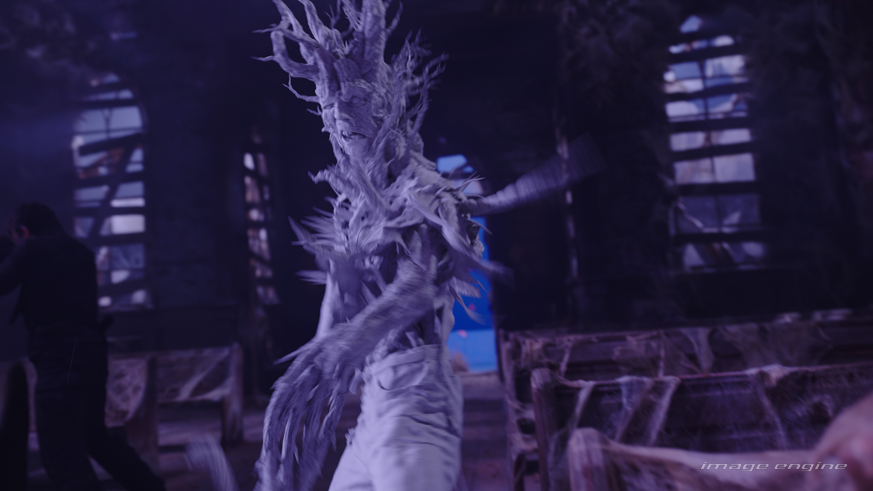
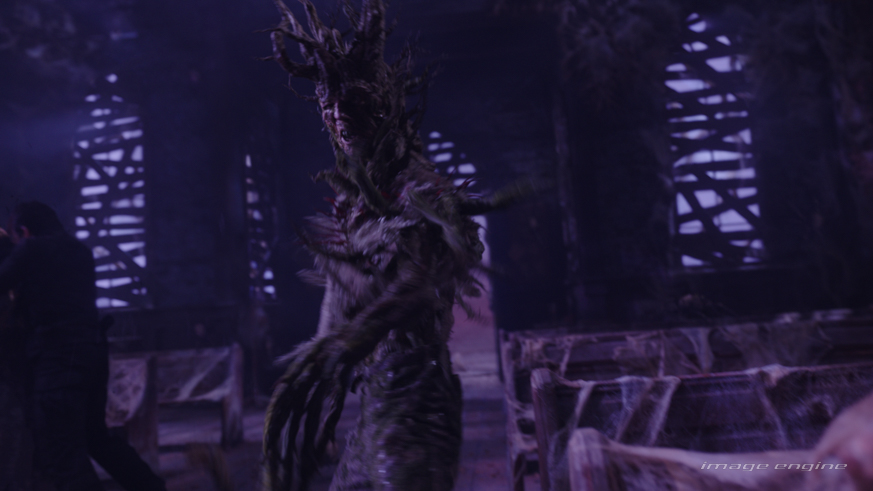
Q: What was the concept behind the hollowmen?
Daniel: The hollowmen were designed as humans partially mutated by plant DNA due to the Gorge’s toxic mist. They existed in a disturbing limbo between human and otherworldly. I produced 4K concept studies, reference boards, and personal texture photos from decaying wood, vines, and moss. These grounded the look in natural realism while maintaining horror surrealism.
Q: What references were used?
Daniel: I provided 4K concept studies, reference boards, and even took my own texture reference photos from decaying wood, vines, and moss in South Surrey. These helped the team build detailed, realistic assets.
Q: How were the Hollowmen creatures brought to life?
Ryan: Given the complexity of the assets, coordination between departments was crucial. We pushed early on with layout and animation renders to lock in their look and ensure they felt right from the start. The asset team did a fantastic job on the creatures to hit the creative look, combined with the anim, creature fx, lighting and comp, the result was very successful!
Richard: We started by doing draw-overs on the edit to determine where each hollowman variation would appear in each shot. Based on camera angles, we often swapped limbs left to right to ensure their mutations were always visible.
Their mutated features were heavily influenced by the motion of the stunt actors’ performances. We adjusted the animation to work with what the actor was doing. If a creature had long vine-like growths on its arms, we reworked its motion to reflect that weight and make it feel like a part of its attack style. They filmed stunt actors performing the choreography with the actors, then we replaced the stunt actors with our CG hollowmen versions and replaced or enhanced the animation to feel more aggressive. They couldn’t feel like stunt actors, they had to feel like their mutations were determining how they moved. If they had long vines coming from the arm, we would rework the animation to make it feel like the motion was adapted to having that weight on its arm and using that feature to determine how it attacked. They needed to feel threatening but not athletic. They were mutated in a way that made them strong, but not fluid like a normal body would move, as if they had forgotten how to be human.
Q: How did you differentiate each hollowman?
Daniel: We visualized mutation on a “DNA slider,” with humanity on one end and full plant transformation on the other:
- Winston – Overgrown with thorns, moss, and rotten wood.
- Roscoe – Plant-infused upper body, with thorned vine-arms used like whips.
- Merle – A hybrid featuring insect DNA, honeycomb textures, and embedded bees.
- Wilfred – The most mutated, though ultimately cut from the final film.
Beyond these, we designed bespoke assets for key set pieces like the Church and Silo, reinforcing the film’s visual themes of decay and human transformation.
A twisted network of horror
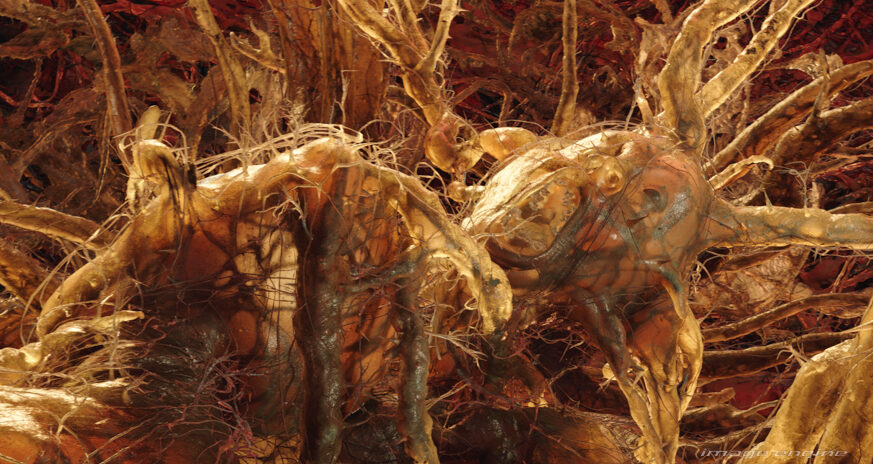
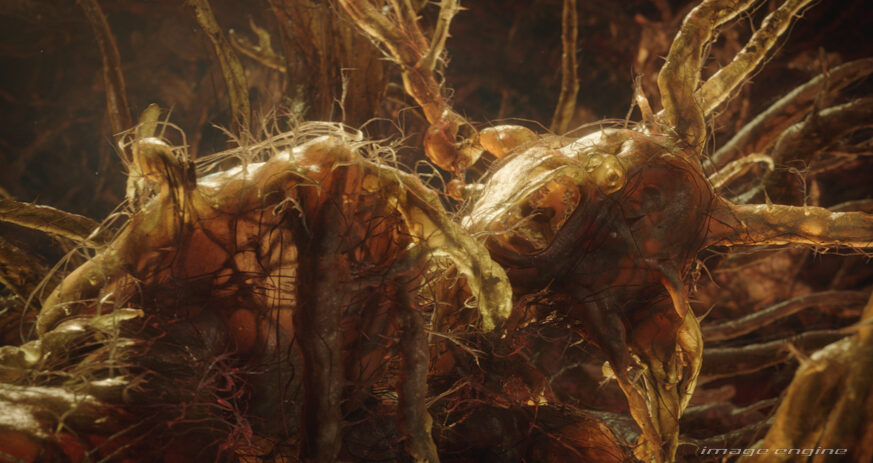
During their expedition, Levi and Drasa discover an abandoned facility filled with horrifying organic matter known as the bodyweb. The twisted flesh and roots pulse and breathe, creating one of the film’s most disturbing sequences.
Q: How was the first proof of concept shot developed?
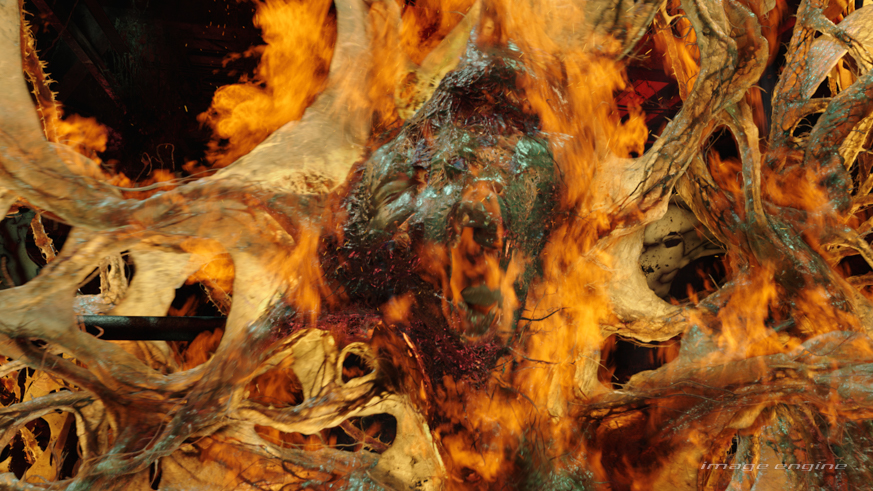
Daniel: We worked closely with VFX Supervisor Christian Irles to produce broad-stroke concept explorations. The director selected one of our early pieces as closest to his vision, leading to Image Engine being awarded the sequence. I collaborated with look dev artist Clint Rea to design the sequence’s key imagery – bodies fused together, breathing within the mass. We focused on translucency, veins, and vine-like details to suggest life within decay.
Q: What was your approach to designing the bodyweb?
Daniel: Christian and I created a biological logic linking plant roots with the human nervous system. This gave structure to the madness. We had to determine how much of each character remained human, and how much had been overtaken by growth.
During production, I worked under Head of Assets Barry Poon and Asset Supervisor Geoff Pedder, identifying which elements needed bespoke designs to maintain visual continuity across shots.

Q: How was the concept refined and developed?
Daniel: For one of the key shots, I created three core drawings focusing on:
- Distended limbs and necks for unease
- Organic details unifying the asset team’s builds
- Visual continuity to tie each body together within the narrative
Gabriel: This sequence required deep collaboration between concept art, lighting, compositing, and the guidance of our visual effects supervisor. We had several iterations where we would contribute with ideas, trying to figure out the key “ingredients” that would achieve the perfect look of blending horror and realism in the final shots.
Q: What was the biggest challenge?
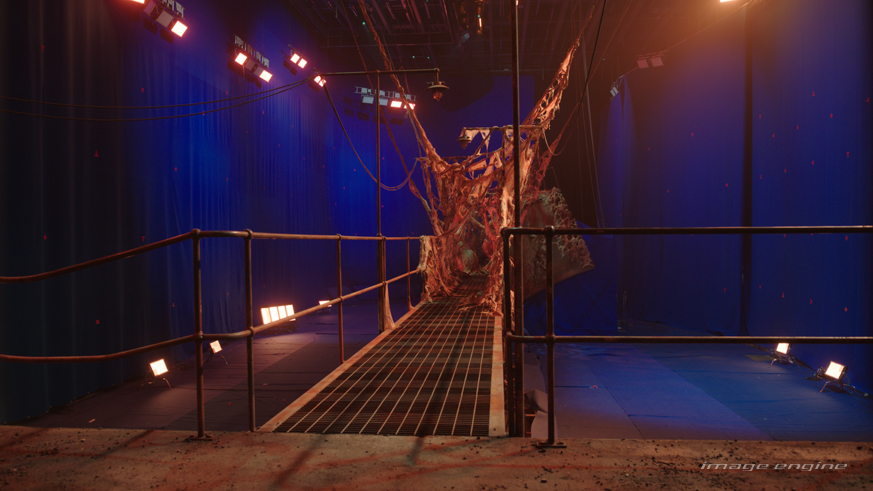
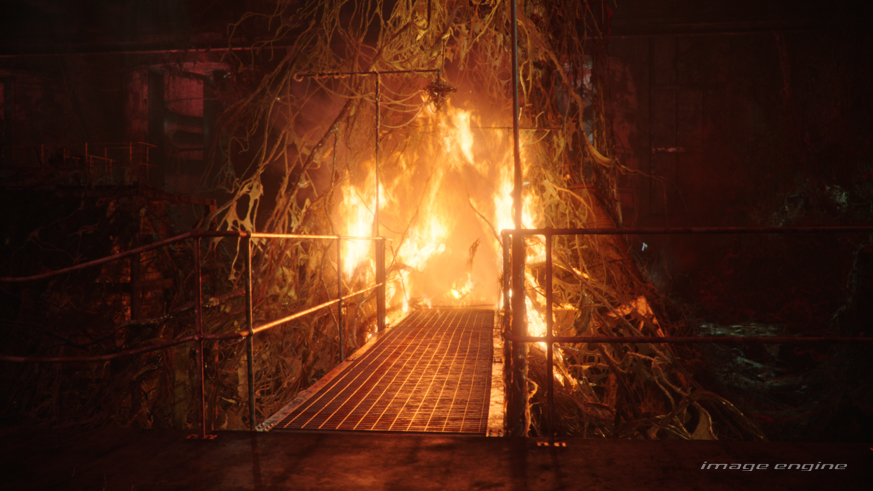
Gabriel: The bodyweb was one of the most challenging sequences I’ve worked on in my career. It was extremely challenging to coordinate all the complex and granular art direction inside the bodyweb, but it was extremely satisfying to see it all falling into place once it started to.
For the compositing department, we had to take several steps to figure out aspects of the bodyweb look, and every shot needed careful coordination to make the sequence cohesive. Matching it to the plate photography and keeping the storytelling intent intact was key.
Daniel: The wide establishing shot of the bodyweb was particularly complex — as the camera drifted, we had to adjust lighting and geometry to preserve the intended direction and maintain narrative clarity.
Q: Were there any significant technical innovations on this project?
Xander: We redeveloped several proprietary publishing tools to speed up the iteration process, particularly for FX publishing. The bodyweb sequence was incredibly complex, with large-scale 3D assets that needed to feel alive. To achieve this, we simulated movement throughout the entire organic structure, which required heavy technical resources. We developed new caching tools that split the geometry into chunks, allowing parallel processing on our render farm.
We also built an in-house render distribution system from scratch, enabling lighting artists to split frames into multiple pieces across several render blades. This significantly reduced turnaround times, allowing us to get approvals faster. Instead of waiting long between iterations, we could quickly refine shots for the client and meet creative deadlines more efficiently.
Of course, this approach was resource-intensive, but our strong collaboration with technical artists and farm managers ensured that our render farm operated at peak performance. Any errors or inefficiencies were quickly identified and optimized, keeping the system running at maximum capacity throughout the project.
Bringing The Gorge to life
From the earliest sketches to the final rendered frames, The Gorge pushed every creative and technical boundary. Through close collaboration between concept, assets, animation, and compositing departments, Image Engine brought to life a world where nature, decay, and body horror collide.
Every element – from the skittering skull spiders to the pulsating bodyweb – served the story’s surreal and terrifying vision. Congratulations to our incredible team for their imagination, dedication, and craftsmanship in shaping this unforgettable film. See the full list of artists who contributed to this achievement below.
